
CSS 2027 Optional Subjects: A Last-Minute Reality Check Before You Apply
At a glance
- Who this is for: CE-2027 candidates who qualified the MPT and are choosing optional subjects before the application window closes
- The date: today is Sunday 22 November 2026 — online applications close on Wednesday 25 November 2026, three days from now
- The structure: the written examination carries 1,200 marks — 600 compulsory and 600 optional; optional subjects must total exactly 600 marks across seven groups
- The rule in one line: one 200-mark subject from Group I, 200 marks from Group II, and two 100-mark subjects from two different groups among Groups III–VII
- The warning: FPSC’s rules state the selected combination is final after the closing date for applications — there is no later chance to swap a subject
- What this guide does: explains the verified group rules, shows valid and invalid combinations, gives general guidance on choosing by background, and ends with a checklist to run before 25 November
Optional subjects are half your written marks. Three days is enough time to check your combination against the rules and test it against a past paper — it is not enough time to rebuild a choice you made on a rumour.
Outline
- How Optional Subjects Work (600 Marks)
- Choosing by Background and Scoring
- Combinations to Avoid
- What You Cannot Change Later
- Checklist Before 25 November
- Key Takeaways
- Conclusion
How Optional Subjects Work (600 Marks)
The CSS written examination carries 1,200 marks: 600 compulsory and 600 optional. Every candidate sits the same six compulsory papers, each worth 100 marks. The optional 600 marks are where candidates differ — and where the rules are strictest. You do not pick any six subjects you like. FPSC arranges optional subjects in seven groups, and your selection must follow the group rules in Appendix I of the CSS Competitive Examination Rules, 2019. A combination can add up to 600 and still be wrong.
The structure is three blocks:
- Group I — 200 marks. Choose one subject of 200 marks from five: Accountancy & Auditing, Economics, Computer Science, Political Science, International Relations. You cannot choose two Group I subjects — Political Science and International Relations together, for example, is not allowed even though both are popular.
- Group II — 200 marks, with two routes. Either choose one 200-mark subject, Physics or Chemistry; or choose two 100-mark subjects from Applied Mathematics, Pure Mathematics, Statistics and Geology. You cannot mix the routes: Physics plus Applied Mathematics is not a valid Group II choice, and neither is Physics plus Chemistry.
- Groups III–VII — 200 marks. Choose two 100-mark subjects, one from each of two different groups. You may take Sociology from Group VII and Gender Studies from Group V; you may not take Sociology and Anthropology together, because both sit in Group VII.
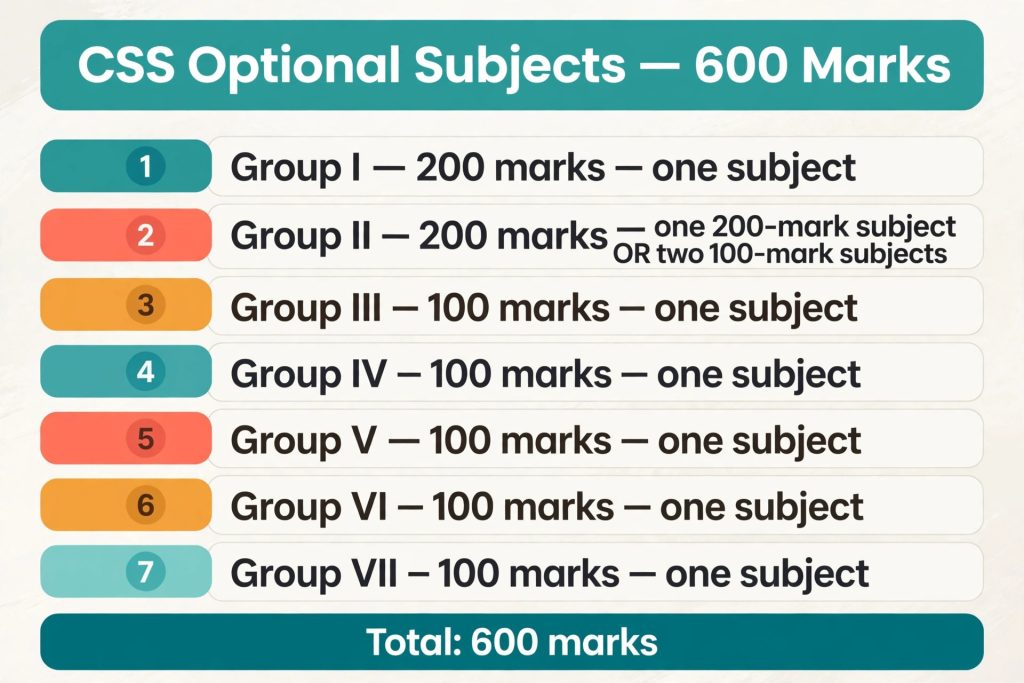
A 200-mark subject means two papers of 100 marks each. A 100-mark subject means one paper. So the full written examination is twelve papers: six compulsory, and six optional papers built from your Group I subject (two papers), your Group II choice (two papers, or two one-paper subjects) and your two Group III–VII subjects (one paper each).
The subjects in Groups III–VII are:
- Group III (100 marks, choose one): Business Administration, Public Administration, Governance & Public Policies, Town Planning & Urban Management.
- Group IV (100 marks, choose one): History of Pakistan & India, Islamic History & Culture, British History, European History, History of USA.
- Group V (100 marks, choose one): Gender Studies, Environmental Sciences, Agriculture & Forestry, Botany, Zoology, English Literature, Urdu Literature.
- Group VI (100 marks, choose one): Law, Constitutional Law, International Law, Muslim Law & Jurisprudence, Mercantile Law, Criminology, Philosophy.
- Group VII (100 marks, choose one): Journalism & Mass Communication, Psychology, Geography, Sociology, Anthropology, Punjabi, Sindhi, Pashto, Balochi, Persian, Arabic.
One practical point that catches candidates out: papers in Urdu or a regional language (Punjabi, Sindhi, Pashto, Balochi) or in Persian or Arabic must be answered in that language. If you cannot write fluently in the language, do not choose the subject on the strength of spoken familiarity alone.
Choosing by Background and Scoring
There is no officially “best” combination, and FPSC publishes no subject-wise averages — any claim about which subjects score better comes from candidate patterns and past mark sheets, not from FPSC. Treat such claims as a signal, not as certainty. What follows is general guidance, not an FPSC announcement.
Start with what you can actually study for months. A 200-mark Group I subject is one-third of your optional marks and two full papers. It needs sustained reading across a large syllabus. Choose the Group I subject whose syllabus you can read without reducing it to memorised headings, and test yourself with a past paper before you commit: can you write an analytical answer that addresses the exact question, under time pressure?
Match the subject to your background honestly. A degree in a subject helps only if it covered the FPSC syllabus. A general business degree does not automatically give you command of the technical parts of Accountancy & Auditing. Everyday computer use is not academic Computer Science. Economics is not current affairs with numbers — it needs comfort with concepts, models and the logic behind them. Check the published syllabus for each subject you are considering, topic by topic, and mark what you already know against what you would have to learn from scratch.
Look for overlap with the compulsory papers. This is the one free advantage in the system. Political Science and International Relations both draw on the same base knowledge as Current Affairs and Pakistan Affairs, so preparation in one feeds the other. History of Pakistan & India overlaps with Pakistan Affairs. Gender Studies, Environmental Sciences and Governance & Public Policies all connect to essay and current-affairs material. Overlap does not make a subject easy, but it does cut the total reading load — and with the written examination tentatively starting on 27 January 2027, reading load is the real constraint now.
Weigh the two Group II routes carefully. Two 100-mark subjects are not automatically lighter than one 200-mark subject. They still mean two complete syllabi, two sets of notes, two revision cycles and two examination papers. Applied Mathematics and Pure Mathematics demand sustained problem-solving; Statistics needs comfort with quantitative reasoning and interpretation; Geology has its own technical vocabulary. Choose the route that fits your existing foundation, not the one whose titles carry smaller numbers.
Be wary of popularity. The most-picked optional subjects are not necessarily the highest-scoring, and a subject that suits thousands of other candidates may not suit you. A short syllabus you can finish and revise twice beats a fashionable syllabus you never complete. With three days left before applications close, the honest test is simple: pick the combination you can defend in one sentence — “I chose this because I have the background and I have read its syllabus” — and if you cannot, keep looking.
Combinations to Avoid
These examples show the arithmetic and the group rules. They are not recommendations for any particular candidate.
Valid combinations:
- Political Science (200) + Physics (200) + Criminology (100) + Sociology (100) — one subject from Group I, one 200-mark subject from Group II, and one subject each from Groups VI and VII.
- International Relations (200) + Applied Mathematics (100) + Statistics (100) + European History (100) + Gender Studies (100) — Group II uses its permitted two-subject route; the remaining 200 marks come from Groups IV and V.
- Economics (200) + Chemistry (200) + Public Administration (100) + Geography (100) — the marks total 600 and the two 100-mark subjects come from different groups.
Invalid combinations:
- Political Science (200) + International Relations (200) + Physics (200) — both Political Science and International Relations are in Group I, and only one Group I subject is allowed.
- International Relations (200) + Physics (200) + Chemistry (200) — Physics and Chemistry cannot both be selected; Group II permits one 200-mark subject or two specified 100-mark subjects.
- Economics (200) + Physics (200) + Sociology (100) + Anthropology (100) — Sociology and Anthropology are both in Group VII; the two 100-mark subjects must come from two different groups.
- Any combination totalling more or less than 600 optional marks — the total must be exactly 600.
Two mistakes deserve a special warning because they appear in guides circulating online. First, some guides wrongly say Group I allows two 100-mark subjects. It does not: Group I is one subject of 200 marks only, and the two-subject route exists only in Group II. Second, some guides describe the Groups III–VII choice as “any two subjects”. It is not: the two subjects must come from two different groups. Check your combination against the group list above, not against a coaching-centre chart or a combination shared by another candidate.
What You Cannot Change Later
FPSC’s rules state that the selected combination is final after the closing date for applications. In practice, candidates should treat their optional subjects as locked the moment they submit: the subjects you enter in the online application are the subjects you will sit in the written examination. There is no later window to swap a subject you regret, and no way to sit a paper you did not select.
That finality is what makes this a last-minute reality check rather than a casual guide. Three things follow from it:
- Do not submit first and decide later. The application form is not a draft. Enter a combination only when you have checked it against the group rules and read the syllabi of every subject in it.
- Do not copy another candidate’s combination. A combination that is valid and sensible for a candidate with a mathematics degree may be a poor choice for a candidate with a humanities degree. Validity is not the same as suitability.
- Keep a record of what you submitted. Save or print the submitted form and the fee receipt, and keep them with your hard-copy documents. If any question about your subjects arises later, your own copy is the fastest way to answer it.
The rest of the application has the same finality of timing, if not of content. Online applications for CE-2027 run from 10 to 25 November 2026, the fee is Rs. 2,200 paid online through a PSID generated after login (through the 1-Link facility), the hard copy of the application must reach FPSC by 4 December 2026, and only candidates who qualified the MPT for CE-2027 are eligible to apply. The PSID is generated online after you log in — follow the portal’s own instructions for it, since published sources disagree on its digit length and this guide does not state it as settled.
Checklist Before 25 November
Run through this list before you submit. It takes an hour; a wrong combination costs a year.
- Add up the marks. Group I (200) + Group II (200) + two subjects from two different groups among III–VII (100 + 100) = exactly 600. No more, no less.
- Check every subject against its group. Write each subject next to its group number and confirm no group appears twice, except Group II’s permitted two-subject route.
- Read the syllabus of every subject you selected. Not the title — the topic list. If a syllabus has large sections you have never studied, decide now whether you can realistically cover them before 27 January 2027.
- Attempt one past-paper question per subject. Not by reading the question — by writing an answer, timed. If you cannot produce a structured answer, the subject needs more preparation than the remaining weeks allow, or a different choice.
- Check the language rule. If you selected a literature or regional-language subject, confirm you can write the paper in that language.
- Confirm the application details. You are an MPT CE-2027 qualified candidate; the fee of Rs. 2,200 is paid online through the PSID generated after login; the online window closes on Wednesday 25 November 2026; the hard copy must reach FPSC by 4 December 2026.
- Keep copies. Save the submitted form, the fee receipt and the hard-copy checklist together, so nothing about your application depends on memory.
Key Takeaways
- The written examination is 1,200 marks: 600 compulsory and 600 optional. Optional subjects must total exactly 600 marks across seven groups.
- Group I: one subject of 200 marks. Group II: one 200-mark subject (Physics or Chemistry) or two 100-mark subjects (from Applied Mathematics, Pure Mathematics, Statistics, Geology). Groups III–VII: two 100-mark subjects from two different groups.
- A combination can total 600 and still be invalid — two subjects from the same group, both Physics and Chemistry, or two Group I subjects all break the rules.
- FPSC publishes no subject-wise averages, so “high-scoring subject” lists are informal guidance from candidate patterns, not official data.
- The selected combination is final after the closing date for applications — the subjects you submit are the subjects you sit.
- Online applications close on Wednesday 25 November 2026, three days from today; the hard copy is due by 4 December 2026 and the written examination is tentatively from 27 January 2027.
Conclusion
Optional-subject selection is the one decision in the CE-2027 application that cannot be undone, and it is worth half your written marks. The rules themselves are simple — 200 from Group I, 200 from Group II, 100 each from two different groups among III to VII — but they are easy to get wrong when a combination is copied from a guide, a chart or another candidate. Spend the remaining three days checking your combination against the group list, reading the syllabi, and writing one timed answer per subject. If the combination survives that test, submit it with confidence. If it does not, change it now, while changing it is still possible.
This is an original guide written for csspastpapers.pk. It is not an FPSC official notice, and this site is not affiliated with FPSC. The subject-group structure follows the FPSC CSS Competitive Examination Rules, 2019 (Appendix I) and the FPSC revised scheme/syllabus as restated by two independent sources that agree in full; candidates should confirm the current rules and the CE-2027 notice on fpsc.gov.pk before submitting. Application dates and fees stated here follow FPSC Public Notice No. F.2/1/2026-CE (8 November 2026): online applications 10–25 November 2026, fee Rs. 2,200, hard copy by 4 December 2026, written examination tentatively from 27 January 2027, only MPT CE-2027 qualified candidates eligible. The PSID digit length is not stated as settled in this guide, since sources disagree; follow the portal’s own instructions.
Related links: CSS 2027 Written Exam – 5 Days Left to Apply; CSS 2027 Written Exam – Hard Copy Submission Guide; CSS MPT 2028: How to Start Preparing Now.